Skip to content

Epoxy Flooring in Guelph

Epoxy Flooring & Garage Floor Coating in Guelph

An epoxy floor turns bare, dusty, salt-stained concrete into a hard, sealed surface that wipes clean. Guelph Flooring Pros installs epoxy and polyaspartic coating systems in garages, basements, workshops, warehouses and commercial units across Guelph and the surrounding towns. We are an installation contractor with more than 15 years and 1500 jobs behind us, and concrete coatings are part of our everyday work.

An epoxy garage floor lives a hard life in Ontario. Winter brings road salt and slush, summer brings hot tires, and the slab underneath breathes moisture year-round. A coating only survives that if the concrete is properly prepared, tested and repaired first.

This page explains why so many epoxy floors fail, how we prepare concrete, which coating systems suit which spaces, how long a professional epoxy floor lasts and what it costs in Guelph. It also answers the question Google raises by showing DIY kits on this search: is a professional coating really worth it?

  • 15+ years
  • 1500+ jobs
  • WSIB covered
  • 2-year labour warranty
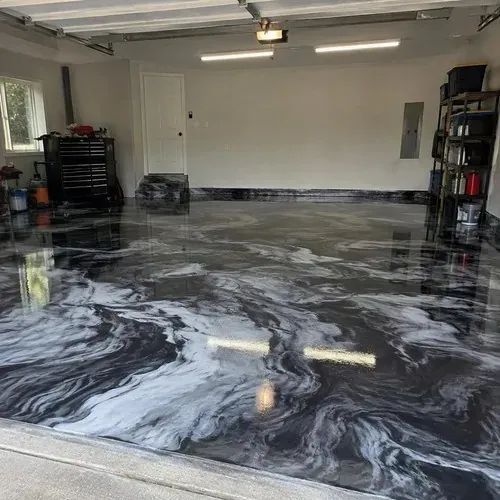
Black and white marble-look epoxy garage floor after epoxy floor installation

1500+

floors completed

Most Failed Epoxy Floors Peeled Because Nobody Ground the Concrete

The typical failure looks the same every time. Patches peel in the tire lanes, flakes lift near the garage door, and the coating comes up in sheets with a thin layer of concrete dust stuck to the back.

That's a bonding failure. The coating stuck to the loose surface layer of the concrete instead of to solid concrete, or it was applied over oil, sealer or moisture.

DIY kits and low-cost contractors usually clean the slab with an acid etch and roll coating on the same day. On a sound, clean, dry new slab that can sometimes work. On a 20-year-old Guelph garage floor soaked in salt and oil, it rarely lasts two winters.

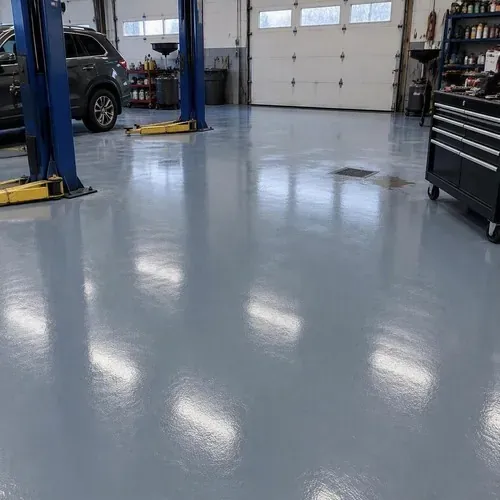
Finished blue-gray epoxy floor in auto shop after epoxy floor installation

Where Epoxy Makes Sense in Guelph

Garages

The most common job, and the harshest environment. A coated floor resists salt, oil and antifreeze and makes winter cleanup far easier.

Basements and home gyms

A sealed, bright floor for workshops, laundry areas and flooring for a home gym, as long as slab moisture tests within limits.

Workshops and warehouses

Chemical resistance, forklift traffic and dust control. See our commercial and industrial flooring page for plant applications.

Commercial kitchens, showrooms and retail

Seamless, cleanable surfaces with slip-resistant aggregate or a decorative metallic finish.

Diamond Grinding, Moisture Testing and Crack Repair

Why We Grind Instead of Acid Etching

Coatings bond mechanically. They need a rough, open surface to grip, measured on the Concrete Surface Profile scale set by the International Concrete Repair Institute.

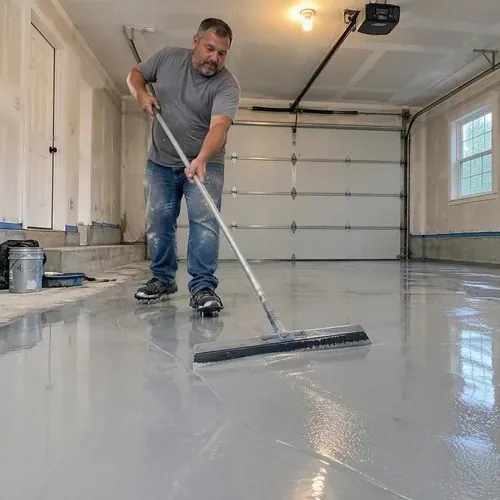
We grind with planetary diamond grinders to reach a profile of about CSP 2 to 3, which removes the weak surface layer, old sealers and embedded contaminants. The grinders run with vacuum extraction, so dust is captured at the head.

Acid etching only dissolves a thin skin of cement paste and leaves salts behind. It gives an uneven profile, doesn't remove sealers and needs a full rinse and drying time the slab rarely gets.
Moisture Vapour Testing Before Any Coating

Concrete slabs transmit water vapour from the ground below. Under an impermeable coating, that vapour builds pressure and pushes the coating off, often in blisters.

Slab moisture is the second biggest cause of failure after poor prep. We test before coating, using a calcium chloride test or in-slab relative humidity probes on larger jobs, and compare the results to the coating manufacturer's limit.

If moisture is high, we use a moisture-mitigating epoxy primer rather than coating and hoping. Basements and older garages without a vapour barrier under the slab are the usual suspects.

Repairing Cracks, Pits and Spalling First

Road salt and freeze-thaw cycles break down the surface of Ontario garage floors, leaving pits and flaking areas called spalling. Coating over them just outlines the damage.

We chase out cracks and fill them with epoxy or polyurea repair compound, patch spalled areas with a rapid-setting mortar and grind everything flush. Control joints are either honoured and filled with flexible sealant or filled solid, depending on the slab.

Coating Systems: Epoxy, Polyaspartic and Flake

Epoxy is a two-part resin that builds a thick, hard, chemical-resistant layer. It bonds very well to properly prepared concrete, but it cures slowly and ambers, or yellows, under UV light.

Polyaspartic is a newer resin that cures in hours rather than days, stays clear under sunlight and tolerates a wider temperature range. It is often used as a topcoat over an epoxy base, combining epoxy's bond with polyaspartic's durability.

Full Flake Broadcast Systems

This is the most popular garage floor finish. After the base coat goes down, coloured vinyl flakes are broadcast until the surface is fully covered, then scraped and sealed with a clear topcoat.

The flakes hide imperfections and small stains, add texture for grip, and give the terrazzo-like look most people picture when they think of a coated garage.

Solid Colour and Metallic Finishes

Solid colour systems in grey, tan or safety colours are standard for warehouses, workshops and commercial kitchens, often with anti-slip aggregate in the topcoat. Lines and walkways can be marked in contrasting colours.

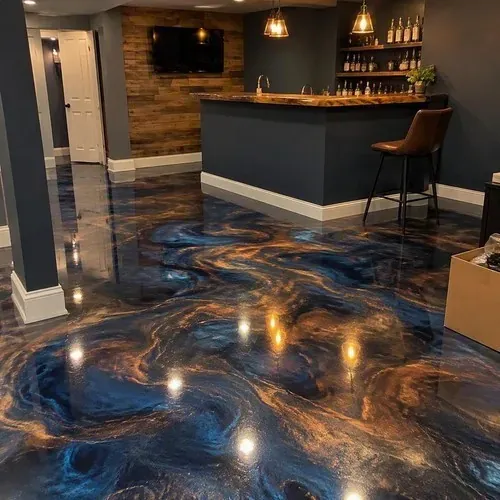
Metallic epoxy uses pearlescent pigments that swirl as they are applied, creating a marbled, high-gloss finish. It suits showrooms, retail units and basement rec rooms.

Polyaspartic Topcoats for Faster Return to Service

For commercial clients, downtime costs more than the floor. A polyaspartic topcoat allows foot traffic in a few hours and vehicle traffic in about 24 to 48 hours, compared with up to a week for some epoxy systems.

That often means a unit can be coated over a weekend and reopened Monday.

How Long an Epoxy Floor Lasts

A professionally ground, moisture-tested floor with an epoxy base and polyaspartic topcoat can last 15 to 20 years in a residential garage. After five years, it should show nothing worse than fine scuffs and some loss of gloss in the tire lanes.

A floor coated over an acid-etched or contaminated slab often shows hot tire pickup, peeling at the garage door and flaking in the drive lanes within one to three years.

The coating itself is only part of the story. Prep quality and the topcoat decide how the floor looks at year five.

Finished metallic swirl epoxy floor in basement bar after epoxy floor installation

What Epoxy Flooring Costs in Guelph

Typical 2026 installed prices in Guelph, including grinding, basic crack repair and coating:

System Installed cost per sq ft
Solid colour epoxy (commercial) $5 to $9
Full flake with epoxy base $6 to $10
Full flake with polyaspartic topcoat $7 to $12
Metallic epoxy $10 to $16

Slab condition moves the price more than the coating choice. Heavy spalling, removal of a failed coating or moisture mitigation can add $1.50 to $5 per square foot. For garage-by-garage pricing, see our garage floor epoxy cost guide.

FAQ

Epoxy Flooring Questions

How much does a 1500 sq ft epoxy floor cost?

For 1500 square feet, a solid commercial epoxy typically runs $7,500 to $13,500, and a full flake system with a polyaspartic topcoat about $10,500 to $18,000. Slab repairs and moisture mitigation are extra.

What is the downside of epoxy flooring?

Standard epoxy yellows in sunlight, cures slowly and can be slippery when wet without an aggregate additive. It also depends entirely on good prep. A polyaspartic topcoat and anti-slip grit solve most of these issues.

What do epoxy floors look like after 5 years?

If the floor was ground and moisture-tested, it will have some light scratches and slightly lower gloss where tires turn. If it was acid-etched or rolled over a sealed or damp slab, expect peeling in the tire lanes.

Can you coat a garage floor in winter?

Only if the garage can be heated. Most coatings need the slab above about 10°C and at least 3°C above the dew point during application and cure. For unheated garages, we schedule between late spring and early fall.

Is epoxy better than a DIY kit from the hardware store?

A DIY kit contains thinner, lower-solids coating and relies on acid etching, and it can't compete with diamond grinding and a multi-coat system. Kits can work on a new, dry, sealer-free slab. On most existing garage floors, they peel within a few years.

Considering a slab without a coating? See concrete polishing and coating.

Free written quote

Book a Garage Floor Assessment

We check the slab, test moisture and recommend the right system before we quote. Call 226-790-3755 or book online.

  1. 1

    Call or send the form

    Tell us the rooms, the floor you want and your timeline.

  2. 2

    Free on-site measure

    We measure, check the subfloor and take moisture readings.

  3. 3

    Itemised written quote

    Every line listed. No deposit needed to receive it.

Open Monday to Saturday 7am to 9pm, Sunday 9am to 5pm.

Call 226-790-3755Free Quote