Skip to content

Concrete Polishing & Coating in Guelph

Concrete Floor Polishing & Coating in Guelph

Guelph Flooring Pros grinds, polishes and coats concrete floors for warehouses, retail units, offices, studios, breweries and basements across Guelph and the surrounding area. We work for business owners, facility managers, general contractors and homeowners who want a durable, low-maintenance floor from the slab they already have.

Concrete polishing is a different trade from laying flooring on top of a slab. It is closer to machining: a sequence of diamond tooling, chemical hardening and burnishing that changes the concrete surface itself. Done well, the result is a hard, bright floor that needs no wax, no stripping and no recoating for many years.

With more than 15 years in the flooring trade and 1500 completed jobs, we use the same planetary grinders, dust extraction and moisture testing for polishing that we use for epoxy prep. This page explains when polishing is the better answer and when a concrete floor coating makes more sense, how the four-stage process works, the finish options, and what concrete polishing costs in Guelph.
  • 15+ years
  • 1500+ jobs
  • WSIB covered
  • 2-year labour warranty
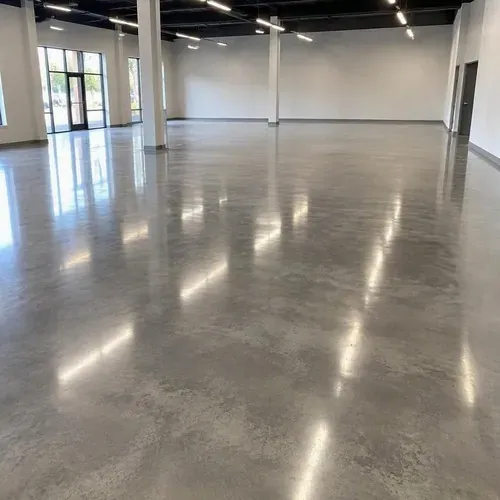
Glossy polished concrete reflecting lights in showroom after concrete polishing and coating

1500+

floors completed

The Floor You Already Have Might Be the Floor You Want

Many businesses budget for a new floor on top of their slab: vinyl, carpet tile or a coating. Often the slab underneath is already a sound, durable surface that just needs finishing.

Polishing turns that bare concrete into the finished floor. There is no product layer to wear through, peel or delaminate, because the surface is the concrete itself, hardened and refined.

For warehouses, retail and light industrial spaces with a good slab, it is usually the lowest lifetime-cost floor available.

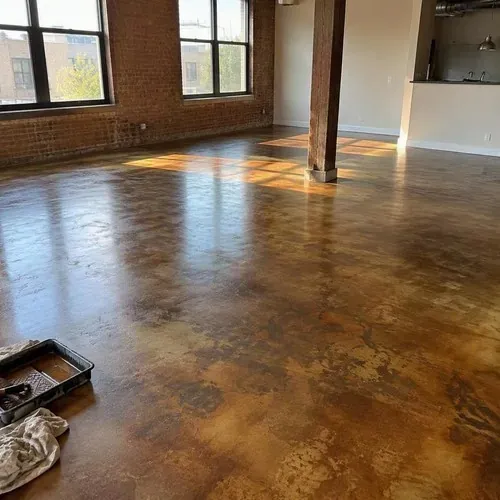
Acid-stained brown concrete floor in loft after concrete polishing and coating

Polished Concrete vs Coated Concrete

Polishing refines the slab. Diamonds grind the surface flat, a densifier hardens it, and progressively finer tooling brings up a sheen.

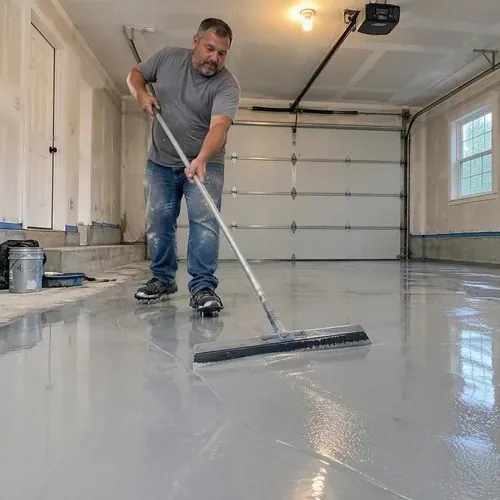
Coating adds a layer over the slab. Epoxy, polyaspartic or urethane resin is applied over a ground surface and forms a separate, sealed skin.

When Polishing Is the Better Answer

Polishing works best on a structurally sound slab without major cracks, spalling or contamination. It suits retail floors, showrooms, offices, warehouses with forklift traffic and modern residential spaces.

It won't peel, it tolerates heavy rolling loads, and it can last for decades with regular cleaning and an occasional burnish. It is also breathable, so slab moisture that would blister a coating is less of a concern.

When a Coating Makes More Sense

A coating is the better choice when the slab is badly damaged, heavily stained or patched, because it hides imperfections that polishing would expose. Coatings also offer much stronger chemical resistance in labs, commercial kitchens and plants handling oils, acids or solvents.

If you need a specific colour, safety line marking or a seamless sanitary surface, a coating gives more control. Our epoxy flooring page covers coating systems in detail.

Grind, Densify, Polish, Seal

Grind

We start with metal-bond diamonds, typically around 30 to 40 grit, to flatten the slab, remove sealers and glue and open the surface. Progressive passes, often through 80 and 150 grit, remove the scratches from each step before.

Densify

A lithium silicate densifier is applied to the ground concrete. It reacts with free lime in the cement paste to form additional calcium silicate hydrate, the compound that gives concrete its strength, making the surface harder and less porous.

Polish

Resin-bond diamonds take the surface from about 100 grit up to 400, 800 and beyond, depending on the gloss wanted. Each step refines the scratch pattern until light reflects evenly.

Seal

A penetrating stain guard is applied and burnished in to resist oil, coffee and other spills. It sits in the surface rather than on top, so it doesn't peel.

Gloss Levels and Exposure

Gloss depends on the final grit. A 400 grit finish gives a low satin sheen, 800 grit a semi-gloss, and 1500 to 3000 grit a high-gloss, mirror-like floor.

Aggregate exposure depends on how deep we grind. A light cut leaves a "cream" finish showing mostly cement paste. A slightly deeper cut shows fine sand and small stone, known as salt-and-pepper, and a deep cut reveals larger aggregate for a terrazzo-like look.

Deeper exposure takes more grinding and costs more. On existing slabs, we grind a test patch first because nobody knows exactly what aggregate is inside until it is exposed.

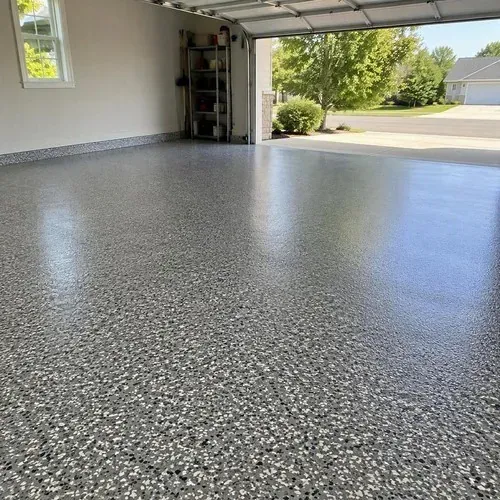
Finished speckled flake-coated garage floor after concrete polishing and coating

Concrete Floors for Guelph Warehouses and Shops

Guelph's industrial parks and business parks along the Hanlon corridor are full of warehouses, distribution units and light manufacturing spaces with bare concrete floors. Bare concrete sheds a fine dust as forklift wheels wear the surface, and that dust ends up on products, racking and equipment.

Densifying and polishing stops that dusting at the source. The hardened surface also resists wheel wear and tire marks.

A polished floor reflects more light than raw concrete, which can brighten a warehouse aisle noticeably. We also fill control joints with semi-rigid joint filler so forklift wheels don't chip the edges.

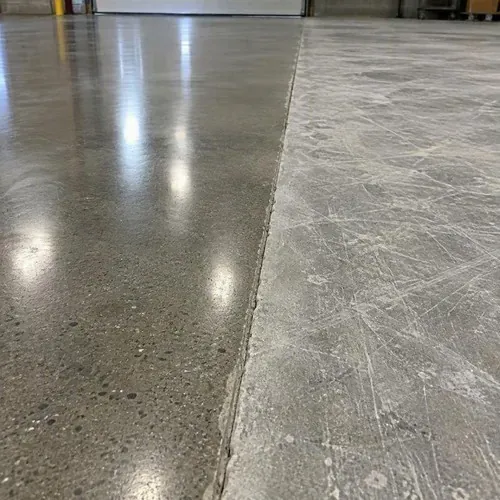
Polished concrete section meeting dull unpolished section after concrete polishing and coating

What Concrete Polishing Costs

Typical 2026 prices in Guelph for existing slabs:

Finish Cost per sq ft
Grind and seal $3 to $5
Polished, satin (400 grit) $5 to $8
Polished, high gloss (1500 grit and up) $7 to $12
Added for salt-and-pepper or full aggregate exposure $1 to $3

Crack repair, removal of old coatings or glue, and very small or awkward spaces raise the price. Large open warehouse floors are at the lower end of each range.

FAQ

Concrete Polishing Questions

Is polished concrete slippery?

Clean, dry polished concrete generally has good slip resistance, often better than polished stone or waxed VCT. Like most hard floors, it becomes more slippery when wet or oily, so wet entrances benefit from mats and a lower gloss level. Slip resistance can be tested on site with a tribometer.

Can any concrete slab be polished?

No. Slabs with heavy cracking, soft or weak surfaces, extensive patches or deep contamination may not polish evenly. We assess hardness and condition and grind a test area before committing to a finish.

How much dust does polishing create?

With our grinders connected to HEPA vacuum extraction, most dust is captured at the grinding head. Wet polishing is an alternative in some spaces, but it creates slurry to manage. Occupied commercial spaces are sectioned off with plastic containment.

Planning a new slab first? See our concrete floor installation page.

Free written quote

Request a Site Visit for Your Slab

We assess the concrete, grind a test patch if needed and quote a finish that suits your space. Call 226-790-3755 or email info@guelphflooring.ca.

  1. 1

    Call or send the form

    Tell us the rooms, the floor you want and your timeline.

  2. 2

    Free on-site measure

    We measure, check the subfloor and take moisture readings.

  3. 3

    Itemised written quote

    Every line listed. No deposit needed to receive it.

Open Monday to Saturday 7am to 9pm, Sunday 9am to 5pm.

Call 226-790-3755Free Quote