Flooring guide
How Much Does a Garage Floor Epoxy Coating Cost?
Most people start pricing an epoxy garage floor after a few Ontario winters have left the slab dusty, salt-stained and pitted. Then the quotes arrive, and one contractor is three times the price of another while a big-box store sells a kit for a few hundred dollars. This guide explains where that gap comes from.
It is written by Guelph Flooring Pros, a licensed, insured and WSIB-covered flooring contractor based on Edinburgh Road in Guelph. We have more than 15 years in the trade and over 1500 completed jobs, including garage coatings for homeowners and larger concrete coating projects for businesses, property managers and builders. The prices below reflect what we see on real Ontario garage slabs in 2026. Every figure is for professional installation with diamond grinding, not a rolled-on coating.
You will find the garage floor epoxy cost for single, double and triple bays, a breakdown of where the money actually goes, an honest look at the true cost of a DIY kit, and why polyaspartic topcoats cost more. We also list the slab conditions that push a quote up, so you can read any estimate with a clear eye. If you want the full installation process rather than the numbers, see our epoxy flooring installation in Guelph page.
- 15+ years
- 1500+ jobs
- WSIB covered
- 2-year labour warranty
1500+
floors completed
Cost by Garage Size
Garage owners think in bays, not square feet, so here is a typical professional price for a full flake system with a clear topcoat.
| Garage size | Typical area | Typical installed cost |
|---|---|---|
| Single bay | 240 to 300 sq ft | $2,000 to $3,600 |
| Double bay | 400 to 600 sq ft | $3,000 to $6,500 |
| Triple bay | 600 to 900 sq ft | $4,500 to $9,500 |
Per square foot, that works out to roughly $7 to $12 for most residential garages. Smaller garages sit at the top of the range because setup, grinding equipment and travel cost the same whether the slab is 250 square feet or 600.
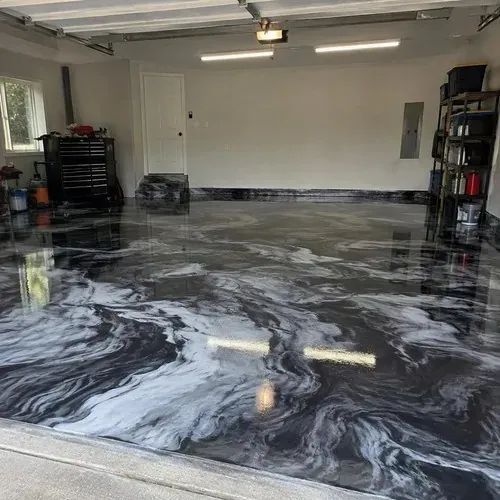
A plain solid-colour epoxy with no flake runs a little less. Metallic finishes, which some owners choose for show garages and workshops, run $10 to $16 per square foot.
What You're Actually Paying For
The coating itself is the smallest part of a professional quote. On a typical double garage, resin, flake and topcoat are often a quarter to a third of the price.
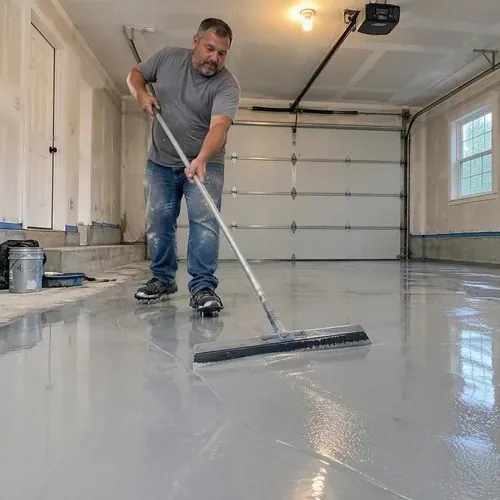
Most of the cost is surface preparation. A diamond grinder with a dust-extraction vacuum removes the weak top skin of the concrete, old sealers and embedded salt, and opens the pores so the coating can bond mechanically rather than just sit on top.
Before grinding, we test the slab for moisture, because vapour pushing up through the concrete is one of the main reasons coatings lift. After grinding, cracks, spalls and pitted areas are filled with repair mortar or epoxy patching and ground flush.
The remaining labour goes into the base coat, the flake broadcast, scraping off loose flake, and the clear topcoat. It is careful, timed work, since each layer has a window in which the next one bonds best.
DIY Kits: The Real Cost
Search for garage floor epoxy and Google shows DIY kits beside contractors. A kit for a single bay looks like a bargain, often a few hundred dollars at a home centre. The kit price is only the start. Doing it properly means renting a concrete grinder and dust vacuum for a day or two, buying crack filler, extra coating for a second coat, rollers, spiked shoes and a moisture test, then giving up most of a weekend or two.
Most kits rely on an acid etch instead of grinding, and use a thinner, lower-solids coating. On a new, clean, unsealed slab that can hold up. On an older Ontario garage floor that has absorbed years of road salt and oil, it often starts peeling in the tire lanes within a couple of seasons.
The expensive part comes after that. Removing a failed coating means grinding it all off before starting again, which typically adds $1.50 to $3 per square foot to the eventual professional job.
Epoxy vs Polyaspartic Pricing
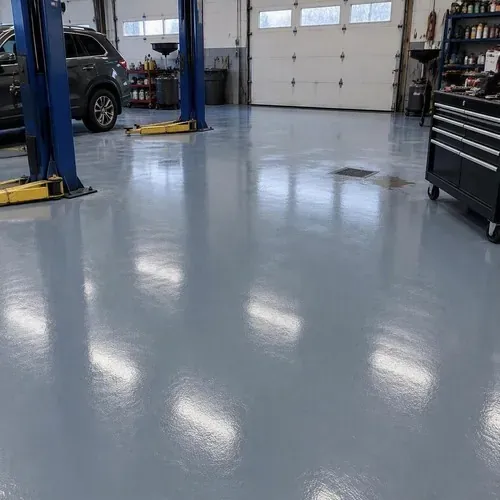
A full flake floor with an epoxy base and a polyaspartic topcoat typically costs about $1 to $2 more per square foot than an all-epoxy system. That premium buys three practical things.
The first is UV stability. Standard epoxy slowly yellows in sunlight, which shows most near an open garage door, while polyaspartic stays clear.
The second is cure time and flexibility. Polyaspartic sets in hours rather than days, so many garages can be coated in one or two days and parked on sooner, and it can be applied in cooler temperatures than most epoxies. That matters in Ontario, where unheated garages drop fast in spring and fall.
The third is surface toughness. A polyaspartic topcoat resists abrasion and hot tire pickup better, which protects the flake layer underneath in the drive lanes.
For a closer look at other finishes, including polished and sealed concrete, see our concrete coating and polishing page.
What Makes a Quote Go Up
Two garages of the same size can differ by thousands of dollars because of the slab. These are the conditions we price for:
Salt damage and scaling
Years of road salt dripping off cars flakes away the concrete surface, especially near the door. Deep scaling needs grinding plus a resurfacing or patching layer.
Spalling and wide cracks
Chipped patches and cracks wider than a hairline need to be cut out, filled and ground flat. Structural cracks that move with frost may need a flexible filler, and we will tell you if the slab has a problem a coating cannot fix.
Moisture
A slab with high vapour emission needs a moisture-mitigating primer before the coating, which typically adds $2 to $4 per square foot.
Previous coatings or sealers
Any failed paint, epoxy or penetrating sealer has to be fully removed first. Sealers are often invisible, so we test for them before quoting.
Oil contamination
Oil that has soaked deep into the slab can stop a coating bonding. It may need degreasing, extra grinding or local treatment.
Extras
Coving the coating up the stem walls, adding anti-slip grit, coating steps into the house and working around storage all add time and cost.
FAQ
Garage Epoxy Cost Questions
How much does a 1500 sq ft epoxy floor cost?
For 1500 square feet, a solid-colour commercial epoxy typically costs $7,500 to $13,500. A full flake system with a polyaspartic topcoat runs about $10,500 to $18,000. Slab repairs, moisture mitigation and coating removal are priced on top, based on what we find when we test the concrete.
Is it expensive to do epoxy flooring?
It costs more than paint or a DIY kit, but less than most other hard flooring per square foot. The real comparison is with doing it twice. A kit that fails in two years has to be ground off and redone professionally, and that combined bill is usually higher than doing it properly once.
How long does a professional epoxy floor last?
A residential garage floor that is diamond ground, moisture tested and finished with a durable topcoat typically lasts 15 to 20 years. Commercial floors under forklifts and daily traffic may need a fresh topcoat sooner. Our work is backed by a 2-year labour warranty.
Let Us Handle It
Prefer to leave it to a professional crew? These are the services this guide covers.
Free written quote
Get Your Garage Measured and Quoted
We measure the garage, test the slab for moisture and old sealers, and give you a written, itemised quote before any work starts. Call 226-790-3755, email info@guelphflooring.ca or book a garage assessment.
- 1
Call or send the form
Tell us the rooms, the floor you want and your timeline.
- 2
Free on-site measure
We measure, check the subfloor and take moisture readings.
- 3
Itemised written quote
Every line listed. No deposit needed to receive it.
Open Monday to Saturday 7am to 9pm, Sunday 9am to 5pm.