Skip to content

Carpet Installation in Guelph

Carpet Installation in Guelph & Wellington County

Carpet is still the warmest, quietest and most comfortable floor you can put in a bedroom, a basement rec room or a staircase. Guelph Flooring Pros installs broadloom, carpet tile and stair runners across Guelph and Wellington County for homeowners, landlords and businesses. Over more than 15 years and 1500 jobs, we have learned that most carpet problems are installation problems.

A good carpet can look tired within a year if it is laid on thin underpad, seamed in the wrong place or not stretched tight. A modest carpet installed properly will stay flat and wear evenly for a decade or more.

This page covers the three carpet products we install and where each belongs, why underpad matters so much, how carpet goes onto stairs, our step-by-step carpet installation process in Guelph and what it costs. If you are also redoing the stairs, our stairs, treads and railings page covers hardwood and mixed options.

  • 15+ years
  • 1500+ jobs
  • WSIB covered
  • 2-year labour warranty
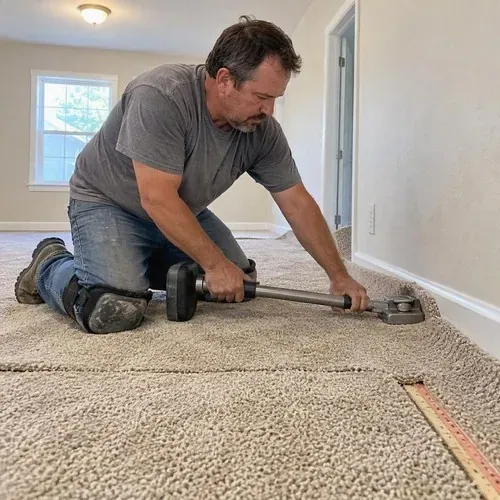
Installer stretching carpet with knee kicker toward wall during carpet installation

1500+

floors completed

Carpet That Ripples After a Year Was Never Stretched Properly

The most common carpet complaint we hear is ripples and waves that appear months after installation. Almost every time, the carpet was pushed into place with a knee kicker alone rather than tensioned with a power stretcher.

A knee kicker is useful for edges, but it can't put enough tension across a whole room. The carpet loosens as it relaxes, and furniture drags it into ridges that trap dirt and wear out first.

The Carpet and Rug Institute's installation standard calls for power stretching on broadloom for exactly this reason. We power-stretch every room, every time.

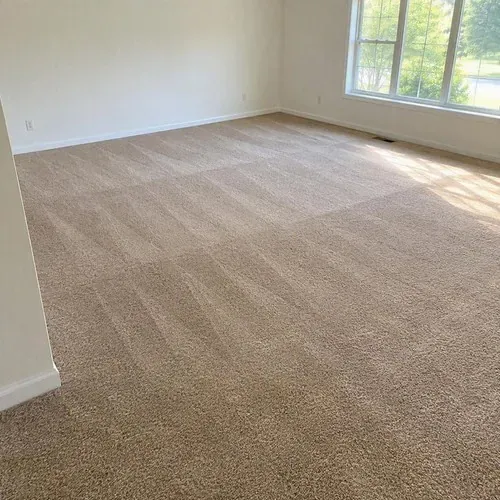
Finished beige carpet with vacuum lines in living room after carpet installation

Broadloom, Carpet Tile or Runner

Broadloom for Bedrooms and Basements

Broadloom comes in rolls, usually 12 feet wide in Canada, and is stretched wall to wall over underpad. It gives the softest feel and the fewest visible joins.

Seam placement matters more than most buyers realise. We plan the layout so seams run away from doorways and out of main traffic lanes, and so the pile direction is the same on both sides of every join.
Carpet Tile for Offices and Rentals

Carpet tiles are usually 24 by 24 inch squares glued down with a releasable adhesive. If a tenant spills coffee or a chair wears a patch, you replace a few tiles instead of the whole room.

That is the commercial argument, and it applies to rental basements too. Carpet tile is also easier to install around office furniture and can be done in phases. See our commercial and industrial flooring page for office specifications.

Stair Runners and Full Stair Carpet

Stairs are the hardest carpet job in the house. Every tread and riser is cut, tucked and fastened individually, and a sloppy stair shows every mistake.

Full stair carpet covers each tread wall to wall. A runner leaves a strip of hardwood visible on each side and needs accurate centring from top to bottom.

Underpad Is Half the Floor

Underpad decides how carpet feels underfoot and how long it keeps its look. A thin, low-density pad lets the carpet backing flex with every step, breaking down fibres and backing faster.

For most homes, we recommend a rebond pad around 7/16 inch thick with a density of 8 lb. Stairs and high-traffic halls get a firmer, thinner pad to hold the carpet tight over the nosing.

In basements, we use a pad with a built-in moisture barrier over dry concrete. Many carpet manufacturers set minimum pad specifications, and using a cheaper pad can void the carpet warranty.

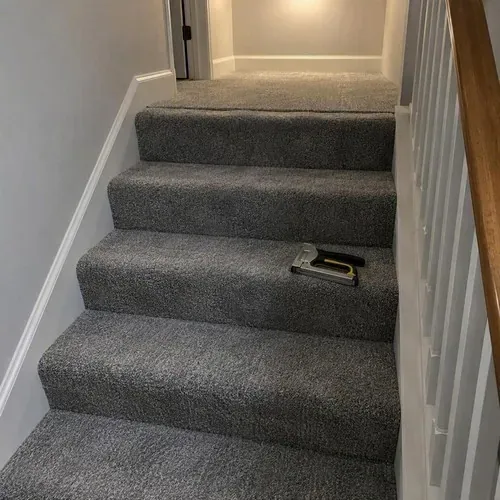
New gray carpet installed on staircase and landing after carpet installation

How Carpet Gets Installed on Stairs

Carpet on steps is one of the most searched carpet questions, and for good reason. There are two main methods, and they look quite different.

Waterfall installation runs the carpet over the edge of each tread and straight down to the next, with no tuck under the nosing. It is faster and suits thicker carpets.

Upholstered or "Hollywood" installation wraps the carpet tightly around each nosing and tucks it under, following every step's profile. It looks more tailored and costs more because each step takes longer.

With either method, we use tack strip on each tread and riser junction, a firm stair pad cut to each tread, and staples under the nosing. On open-sided stairs, the exposed edge is bound or wrapped for a clean finish.

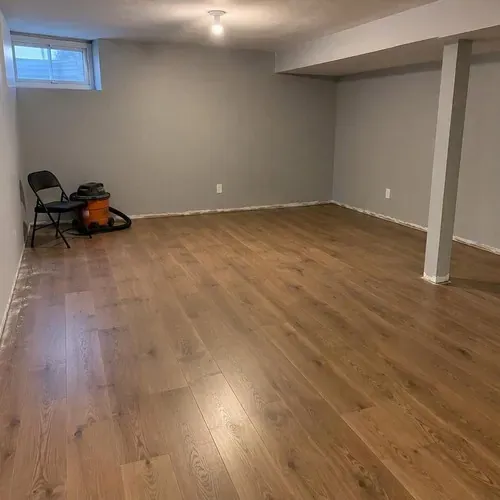
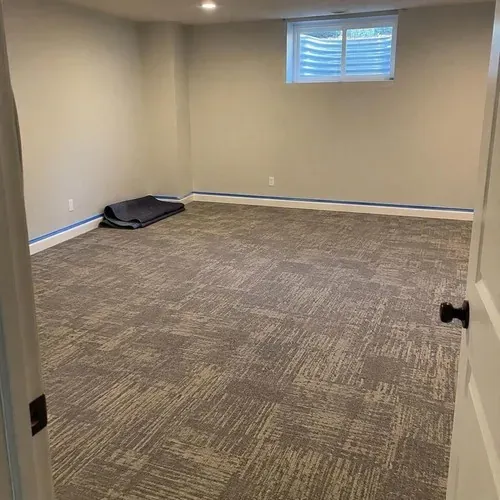
New patterned carpet in basement rec room after carpet installation

Our process

Our Carpet Installation Process

  1. 1

    Old Carpet Removal and Disposal

    We roll up and haul away the old carpet and pad. Then we pull every staple left in the subfloor from the old pad, which cheap jobs leave behind and which show as bumps in new carpet.

    Old tack strip is removed if it is damaged or in the wrong place. We check the subfloor for squeaks, soft spots and pet odour stains, and seal stains before the new pad goes down.

  2. 2

    Tack Strip and Underpad Layout

    New tack strip is nailed around the room perimeter, leaving a gap from the wall slightly less than the carpet's thickness. On concrete, we use strip with hardened concrete nails or adhesive.

    The pad is laid with seams at right angles to the carpet seams, taped together and stapled or glued in place. That keeps the pad from shifting and creating ridges under the carpet.

  3. 3

    Seaming and Power Stretching

    Carpet seams are joined with hot-melt seaming tape and a seaming iron. We cut both edges with a seam cutter and seal them with latex to stop fraying.

    Then we power-stretch the carpet across the room from wall to wall, and hook it onto the tack strip. Edges are trimmed and tucked, and metal or wood transitions are fitted at doorways.

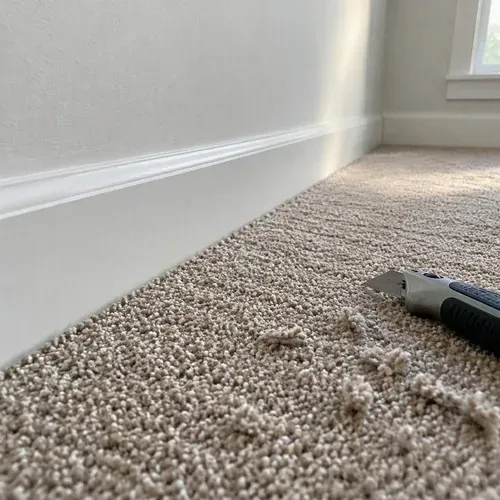
Freshly trimmed carpet edge tucked along baseboard during carpet installation
Every step on your written quote

What Carpet Installation Costs in Guelph

Typical 2026 installed prices in Guelph, including carpet, underpad and labour:

Product Installed cost
Broadloom, mid-range with rebond pad $4 to $9 per sq ft ($36 to $81 per sq yd)
Carpet tile, commercial grade $4 to $8 per sq ft
Stair carpet, labour only $15 to $30 per step
Stair runner, labour only $20 to $40 per step
Old carpet and pad removal $0.50 to $1 per sq ft

FAQ

Carpet Questions

How much does it cost to carpet a set of stairs?

Stair carpet is priced per step. A typical 13-step straight staircase costs roughly $200 to $400 in labour, plus carpet and pad. Landings, pie-shaped winders and open sides add to the price.

Can you install carpet over concrete in a basement?

Yes, if the slab is dry. We check for moisture first, then install tack strip with concrete fasteners and a pad with a moisture barrier. If the slab shows signs of dampness, carpet tile or a subfloor panel system is a safer choice.

Do you remove and dispose of the old carpet?

Yes. Removal and disposal of old carpet, pad, tack strip and staples is listed on your quote as its own line, so it doesn't turn into a surprise charge.

Free written quote

Get a Carpet Quote, Including Stairs

We price rooms by the square foot and stairs by the step, all on one itemised quote. Call 226-790-3755 or request a free quote.

  1. 1

    Call or send the form

    Tell us the rooms, the floor you want and your timeline.

  2. 2

    Free on-site measure

    We measure, check the subfloor and take moisture readings.

  3. 3

    Itemised written quote

    Every line listed. No deposit needed to receive it.

Open Monday to Saturday 7am to 9pm, Sunday 9am to 5pm.

Call 226-790-3755Free Quote